Showing posts with label Blantyre. Show all posts

Wednesday, March 30, 2011

Week in Malawi: Part Five

Thursday, March 17th

My boss left this morning, on his way back to Lilongwe for a meeting before returning to Nairobi. He elected to fly back to Lilongwe which makes me feel better about the bus ride we shared to Blantyre. I like knowing that he hated it as much as I did. You ride one of those buses and everyone else on board seems to be taking it all in stride, like it’s enjoyable. Your first thought is something like “these people are crazy,” but with each smile you see and normal conversation you hear, a very different thought starts to creep into your conscious, “maybe I’m insane for thinking this is bad.” My boss choosing to fly back proves that he hated it as much as I did and it makes me feel like I might still be normal, not just some whiny bitch. I’ll be here for one more week to continue meeting with distributors and NGOs that buy our pumps. Today, I’m on my way to a small town about 25km from Blantyre where I want to meet with a guy that works directly with farmers as an extension agent for an NGO. But first, I’m on my way to a meeting with Amin, one of Nikhil’s employees who is taking me over to another NGO within Blantyre.

The meeting is pretty short because this NGO just happens to be funding the projects that are using the pumps. There are two other NGOs that are responsible for implementation, and it’s those two organizations I’ll have to talk with to get anything close to what I’m looking for. I write down the names and phone numbers of a couple of additional contacts that I plan on calling this afternoon. The means by which these pumps actually reach farmers continues to get increasingly complicated, but I’ve found that I like the work involved in trying to understand the process. It’s like an unsolved mystery with an outcome that includes a hard to find farmer and a blue pump.

I decided to check out of the hotel I was staying in the past two nights because the only room they have available is more than I’m willing to pay. After the meeting, I have Amin drive me to Hostellerie de France which I found on Trip Advisor, listed as the second best option for hotels in Blantyre. Most of the reviews on Trip Advisor were pretty good, but there was this doozy which was either intriguing or scary depending on your personality:

Salvador-Dali lookalike proprietor has not heard of personal space and insists on touching his guests, photographing them (without permission) and imagining that all guests are captivated by his charisma. I wasn't. The room was depressing if clean, fan fell to pieces, nylon cover circa 1970 on the bed, and towels of same vintage. Fierce and intimidating dogs in the car park. Long trip to airport. OK for one night if you can avoid Monsieur's clutches.

I decide to take my chances. The hotel is a five minute drive outside of town, set on a large hill with nice views of the valley and city. The French woman that greets us speaks halting English, but we’re able to pretty easily negotiate that I’m looking for a room and would like to see it before deciding whether or not to stay. Hotels around here aren’t anything like their cookie cutter cousins in the states. You’re never really sure what you’re going to get and the rooms can vary to a great degree even within the same hotel. It’s best to see and check everything before committing. She waddles over to the room and shows me inside. I’m an easy customer and am quickly sold. The room is completely adequate, even if it features a shower wand device like Lusaka Hotel’s rather than a full shower. We agree with head nods and before I can say any different, she sends for someone to carry my small bag, explaining with a phrase that makes me laugh. “Me call boy.” Monsieur is currently no where to be found.

After settling in and wishing a good day to Amin, I head out, finally on my way to Llunzu to meet with a field worker. Right outside the hotel, I’m able to flag down a mini-bus that takes me into the Blantyre bus market which is quite a bit nicer than Lilongwe’s but as equally confusing. Situated on both sides of a busy street, there are hundreds of mini-buses all parked or moving in an unorganized snarl. I ask someone for help and he very easily points me in the right direction. I board a white mini-bus that’s nearly full with passengers, has a sticker on the front windshield that says “Fear God,” a wooden sign with the name “Llunzu” by the steering wheel, and looks like it’s held together by two staples and three paper clips. My bus companions shoot me frightened and suspicious stares while the bus driver revs the engine and slowly exits the market, yelling out the window “Llunzu, Llunzu, Llunzu!” We’re off.

The bus trip feels longer than 25km should, but I make it easily and safely. Llunzu is about 1km long with concrete shops on either side of the highway. There are wooden shacks selling tomatoes and onions and forty or fifty “shops” that are more or less plastic tarps laid on the ground with second hand shoes, shirts, and pants displayed on top. I go into a restaurant and call Victor, the field worker I’m meeting. He knows exactly where I am and says he’s riding into town on his motorbike now.

He’s a few years older than I and has a real hard time understanding my accent. I try to talk more slowly but usually have to repeat myself and notice a few times that he’s just nodding yes, not really understanding me. He suggests we go to his “office” which also serves as his home. I get on the back of his motorcycle (looks like a dirtbike) and hold tight while he drives away from the highway, down several different dirt paths/roads that are surrounded by corn fields and a few crudely constructed houses with either tin or thatch roofs. Just a few turns off the highway and it feels very, very rural. Everyone we pass does a very clear double take to get a look at the white guy riding on the back of Victor’s motorcycle, holding on for dear life. His house is a very modest concrete rectangle, painted white, with what appears to be a new tin roof. He has three kids and his brother, who lives next door, has three of his own. All six of them are playing in front of the house when we arrive and they follow us into the front room which for its size, holds too many pieces of furniture. There are two couches that you might find on an Ann Arbor curb, a large side table in the middle of the room, a dining table and three chairs pushed against the wall, a larger than expected TV in the corner, a bookcase with a stereo and speakers, and some sort of wardrobe next to the front “window.” I make myself at home on one of the couches while Victor makes each kid come up to me to shake my hand. None of them dare utter a word to me and I’m tempted to yell “boo” a couple of times but hold my tongue and just smile.

It’s been almost three weeks since my trip began and only now am I meeting with someone that works directly with the farmers that are using our pumps. Victor, and the many other NGO field workers, are the keepers of all the data and information I need, and I’m excited to finally talk to someone who knows where the pumps are and who is using them. Victor has distributed around 80 pumps in the past two years, so I start by asking how he keeps track of the farmers’ names and locations. Easy enough, he writes them down. When I ask them if he can show me how/where he captures all this info, he heads over to his bookcase, shuffles around a few piles of paper, grabs two plastic shopping bags full of loose paper and notebooks, and brings them both back over to the couch. Five minutes later, with papers thrown about the couch and floor, he finds what I’m looking for – a small notebook with a bunch of chicken scratch and farmer names scribbled throughout. So this is what I’m trying to track down! A crumpled notebook that sits at the bottom of a plastic shopping bag, resting on a bookcase amid other loose paper, in a concrete house with no running water that’s owned by a worker who has trouble understanding my English and is an hour away from the nearest city and four hours away from the capital, in one of the poorest countries in the world. I don’t like my odds, but I like the challenge.

I also like Victor and have learned a lot of valuable info for my project, so we spend the rest of the afternoon at his house celebrating by watching Malawian music videos. They are something like watching the homemade Spanish music videos made in 1997 for Senora Jackson’s class assignment...except the Malawian versions are lower quality. Victor translates for me and writes down a number of Chichewa phrases that are either useful or come up during the music, so by the time we leave his house I can say “how are you” “do not cry” “problems” “I love you” “don’t fool me” and “feeling sweet/crazy” in Chichewa. We take off on his motorcycle, back through the village, and he drops me off right at the mini-bus that returns me to Blantyre. I know it’s the right bus by the “Fear God” sticker, the same sticker I saw on my bus out of town.

I get back to the hotel and am greeted by a French man who I suspect is “Monsieur.” He speaks slightly better English than the woman who greeted me earlier and though it’s unclear whether or not they are a husband and wife team, it’s quite clear that they both use the same color of hair dye – something between black and purple and looks a little goofy on his Rolly Fingers mustache. After he gets my business card and uses my shoulder to support himself while stepping up on a chair to tack the card next to all the other cards wallpapering the reception room, he generally lets me be. I head back to my room, happy to have successfully avoided the assault on personal space and unwanted pictures I was warned about on Trip Advisor. Safe in my room, I feel pretty good about what I learned today despite discovering the long odds at tracking down the necessary data. I go to sleep practicing my Chichewa. Tseketseke. "I’m feeling sweet/crazy."

Sunday, March 27, 2011

Week in Malawi: Part Four

Wednesday, March 16

On our way to the distributor we’re meeting with today, I get a quick tour of Blantyre and am really impressed after being underwhelmed (and even disgusted in some cases) by Lilongwe. The town feels like a real city with a well laid out downtown and a sense of organization that didn’t exist in Lilongwe and I haven’t experienced in any of the other cities I’ve visited. The streets are hilly and green valleys and mountains surround the city, offering nice views on our short trip from the hotel to the distributor. This distributor is our largest customer and hasn’t replied to any of the 8 or so emails we’ve sent him over the last few months. I’m not sure what to expect.

The building looks more like an office than a store and there’s a receptionist sitting at a desk to our right. Her desk is computerless which I’ve seen a lot the past few weeks but still leaves me wondering what these people do all day besides sit and answer two or three phone calls. Like all the receptionists I’ve met, she whispers when she talks and barely makes eye contact. It annoys me, but being annoyed makes me feel bad and 100% American. We’re confident, loud and direct, and I want the same out of this poor girl that’s likely never spoken to a white American. After a couple of inaudible mumblings she leads us down a dirty tiled hallway and into the office of the man we’re meeting.

Nikhil is younger than I expected, probably in his late thirties, born in Malawi but of Indian descent. He studied in South Africa and Australia before returning to the company his father started thirty years ago in Blantyre. The company sells seeds, fertilizers, and farming equipment and since Nikhil started in 2004, they’ve been growing quickly. Next to the office we’re currently in they are building a large, formal showroom and a warehouse for their inventory, hoping the expansion will significantly improve their store foot traffic and sales. He has two phones on his desk and a cellphone next to his computer. While he’s explaining the new warehouse and how they’re growing, all three phones ring at least once. He picks each call up and speaks quickly in some mixture of English and Chichewa, and then returns to our conversation as if there was no interruption. He’s definitely a businessman.

After introductions but before we start our meeting he offers my boss and me coffee or tea. We both elect for coffee and Nikhil is happy to make it for us. He gets up from behind his desk and walks over to the file cabinet that is directly to our left and rusting at the corners. On top, a can of instant Nestle coffee sits with powdered milk, four mugs that may or may not be cleaned, and a box of tea bags. Before he goes for the mugs, he bends down to the ground where an electric kettle is sitting next to a dusty black shoe box with a white rubber rain shoe that sits on top. The right shoe is nowhere to be found so the left shoe just waits alone and the cobweb between the wall and shoe suggests it’s been waiting for some time. Nikhil leaves to fill the kettle and returns, placing it right back where he found it, on the ground. While he’s down there, he fumbles with three cell phone chargers that are plugged in before finding the kettle plug and plugging it into the wall. I find it really funny that he keeps the kettle on the ground, next to this suspicious shoe, but his whole office is kind of like this. In the right hand corner, between a bookcase and wall, is a pile of newspapers and thrown about receipts. The whole place looks like it was recently ransacked. The left hand corner features more newspapers and two empty boxes of Johnnie Walker Blue Label. The box says how many bottles it holds (or at one time held), and I do the math quickly in my head: 12 x 750ml bottles in each box, about $200 per bottle. The guy spent something around $4800 on scotch yet keeps his kettle on the floor next to a lone white rain shoe. Very suspicious, and based on what he starts explaining to us, I start thinking that maybe his office looks like it was ransacked because it actually was.

Over the instant coffee that tastes more like chemicals than real coffee, we’re talking about the order they’re planning on placing with us. More than 700 pumps that we’ll manufacture in China and ship to Lilongwe and will cost somewhere north of $150,000. In every meeting we’ve had, we’ve heard about Malawi’s “forex problem.” I don’t fully understand the entire problem but from what I can gather, the country doesn’t have enough American dollars within the economy. So, any business or payments that require American dollars is currently not easily happening. For example, we shipped 300 pumps to a distributor in Lilongwe in January and are still waiting for payment because the distributor’s bank won’t release the necessary American dollars to our bank account. Similarly, the order Nikhil wants to make will require payment in American dollars but his bank won’t make the payment because they don’t actually have the invoice amount in American dollars. His solution to this inconvenience is to assure us that he’ll have his “guy in Hong Kong” pay the invoice, but because he has to use him, Nikhil explains he’ll need 120 days after shipment to make the payment, not the standard 30 days. He’s quite comfortable talking numbers, costs, and payment terms. I get the sense that he’s making a lot of these deals, milking out every dollar and benefit he can with a pretty quick and smooth style. A "guy in Hong Kong" sounds like a guy who might loot an office if Nikhil milked out one too many dollars in a recent deal, and I start to wonder if that same guy in Hong Kong is currently wearing a white rain shoe while sipping on a glass of Blue Label scotch.

We finish up our meeting, not really agreeing to anything but with an understanding that an order will indeed be placed. He takes us out for lunch at a surprisingly good Italian restaurant which plays only Motown music (I proudly point this out to my companions) while we’re there. In every developing country I’ve visited, I’ve found at least two or three places that feel like they should be in the states. It might be a coffee shop that offers wireless internet and comfortable chairs or just a restaurant with really good food and first class service. I’ve seen these places come in many forms, but you know the moment you walk in if you’ve found one. It feels so satisfying and relaxing (and decadent and indulgent!) to step into a place like this and for a moment forget about the developing world chaos and absurdity that exists outside its doors. This restaurant is very clearly one of these places, Blantyre’s oasis. I have fettuccini with a mushroom and tomato sauce and happily oblige when Nikhil asks if someone will order a beer with him. The pasta tastes great after a two week diet heavy on fried chicken, French fries, and Coke, and the environment is just what the doctor ordered after yesterday’s long journey. On our way out, I feel reenergized and motivated. Nikhil feels like how I suspect he always feels - ready to make a deal. “David, do you need to exchange any American Dollars for Malawian Kwacha? I’ll give you a real good rate.” He slips me a business card before we depart.

Thursday, March 24, 2011

Week in Malawi: Part Three

Tuesday, March 15th

After breakfast, we head on over to an NGO that uses our pumps in the irrigation programs they run throughout the country. I’ve been corresponding with this group from Nairobi via email and phone and it’s nice to meet some of the people I’ve already worked with. They’ve been remarkably helpful and are much better organized than the NGOs I met with in Zambia.

As a first step in my project, I’m trying to gather the names and locations of all the farmers that are using our pumps in Zambia and Malawi. I figured that the NGOs would definitely have this information readily available and thought it might be as easy as asking them to email me the Excel file. It has proved much more difficult. In Zambia, I found that I’d meet with someone in the capital who would tell me that the info exists but that I’d have to contact the regional office. I’d contact the regional office and they’d say that the info exists but it’s in the hands of the field workers. I’d contact a field worker who would confirm he does have the information but it isn’t compiled in an Excel file or easy to quickly send along to my email. Worse, the names and locations of farmers isn’t sent to the regional or national offices at any point, so getting my hands on this information would mean contacting the hundreds of individual field workers working in remote parts of the country.

The NGO we’re meeting with now has a similar situation – the names and locations of farmers they work with reside in the hands of their field workers. Hearing this news this morning, in a second floor, horribly hot office, makes me want to bang my head against the office wall. I’m deflated, but before I can do anything rash, Olivia, the woman we’re meeting with, gives us some great news. They like the idea of gathering this detailed information and have started to require their field staff to send in the required data. She opens an Excel file where they’ve already organized the names and locations of 900 farmers, a far cry from the 3000 or so pumps they’ve bought in the past two years but a great start. Better yet, they’re using the exact data collection template I created, meaning everything that I’ll need is included, and they’ve hired someone who will compile this information on a quarterly basis. I feel like giving Olivia a high five and a giant bear hug. Instead, we simply finish up the meeting and say goodbye. Once out of the office, my boss describes the meeting as “very fruitful” which makes me silently laugh. I find it a funny adjective to use to describe a meeting but don’t disagree with the assessment.

I like travelling with my boss. We spent a week in Zambia together and now will spend this first week in Malawi together. He’s Kenyan, in his early fifties, and has a tendency to follow up any sentence with a very audible and somewhat long “mmmm.” He’s the director of the export program so most of his job is sales related, trying to secure orders from private distributors, governments, and NGOs that are in countries where we don’t have staff. He travels a lot throughout Africa, and in our first week in Zambia, I could quickly tell he’s used to being on the road, making friends with everyone we come into contact with and expertly negotiating all of our taxi fares. I love letting him handle the taxi fares as I find the negotiation it requires awkward and stressful. I’ve picked up that his favourite tactic is starting with “I have my price and you have your price, so we’ll start at your price.” The price given is always scoffed at and my boss replies that we’ll pay half the stated fare, but we usually pay about 60% of the initial quote. Besides being a good negotiator and an outgoing salesman, he also strikes me as a little clumsy, though I’m beginning to think that it might just be the ridiculously pointy dress shoes he wears. I’ve watched him trip over stairs on two different occasions and had to grab him once after he slipped in the hotel hallway. After saving him from a fall, my hand still snugly in his armpit, he says “Ohhh, thank you! Mmmmmmmmm.”

Today we’re headed to Blantyre, Malawi’s large commercial city in the southern portion of the country. I’m told it’s a four hour bus ride which doesn’t seem too bad, and I’m actually looking forward to a trip into the country. Before we leave for the bus stop, we stop by the distributor we visited yesterday to try to get the additional information they said they would gather. Not surprisingly, the information isn’t waiting for us and we spend thirty minutes waiting while they do what they said they would. Yesterday after explaining what we’re looking for and presenting a few examples of how me might go about working with them to get the data we require, the man in charge reminds us that they’re very busy and doesn’t seem too keen on doing anything more than what they’re currently doing. The “we’re too busy” is a response we’ve gotten a lot over the last two weeks and though I appreciate that we’re asking them to do extra work, I find “busy” a generous way to describe their day. Today, the same man that described his business as “very busy” is busy reading two newspapers while his staff of two handles the heavy foot traffic in the store - one person in the 45 minutes we’re there. Nonetheless, we get the info we were looking for and head over to the Lilongwe bus station.

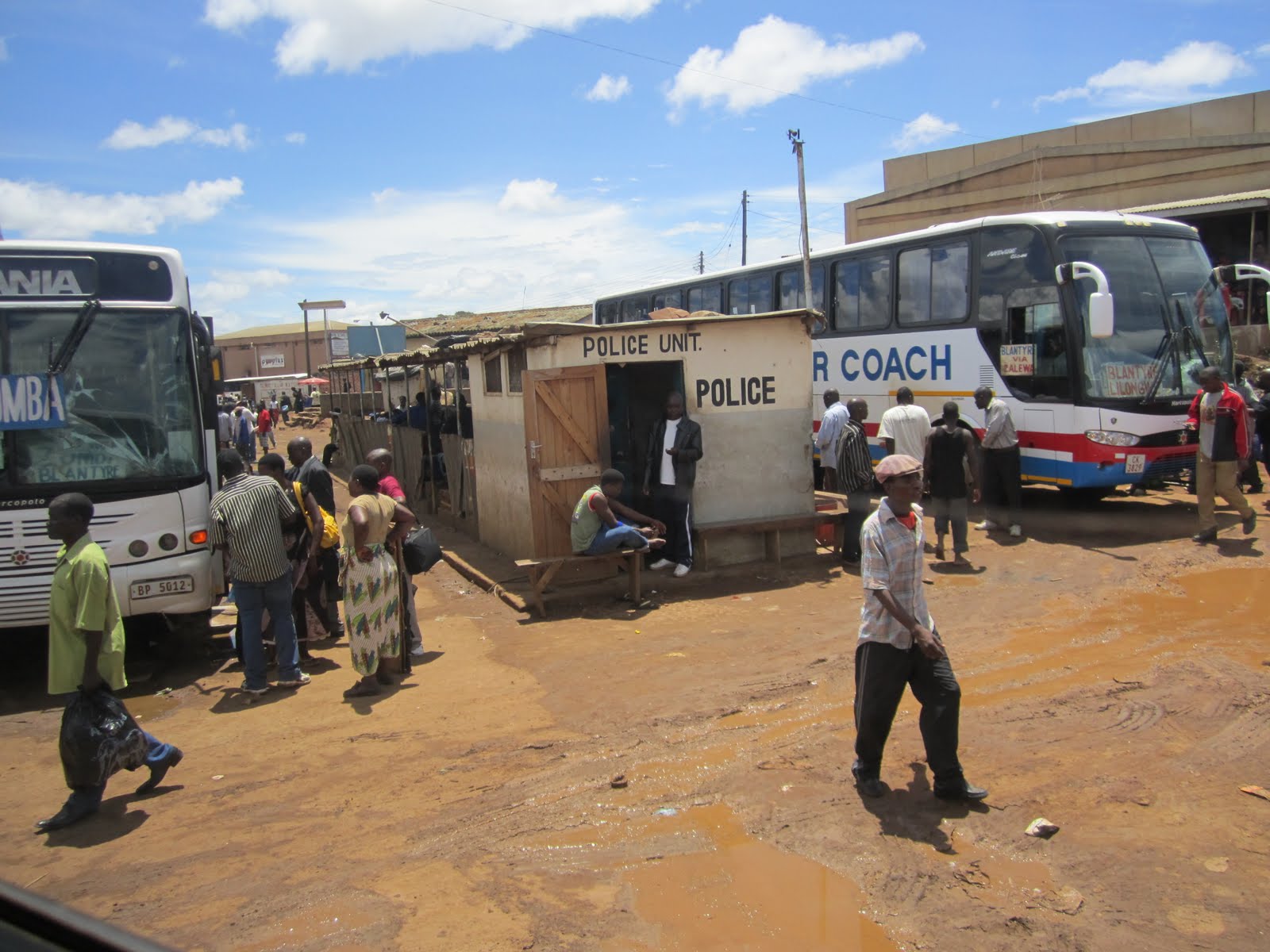
I’ve found that bus stations in developing countries are terribly vile things and would recommend, if you’re visiting one, that you wear closed shoes and jeans. Anything to distance yourself from the filth. Lilongwe’s “station” certainly falls into this category. It’s a disgusting mud filled lot with around 50 beat up buses waiting in an unorganized fashion and hundreds of people aimlessly wandering about looking like they might steal your bag. The moment we exit the taxi is the moment I want to leave. Predictably, there are 8-10 dudes surrounding us right when we get out of the taxi, each yelling, asking, directing. “Where are you going? Yes, boss! Going to Blantyre. This bus, this bus, this bus, this bus. We’re leaving now!” We’re more or less pulled to a bus where a guy quickly starts to scribble a ticket. I know better than to believe this guy who keeps telling us that they’re leaving now and will be in Blantyre in three hours. I’ve learned from very hard experience that these guys will tell you anything you want to hear to just get you on their bus. The bus isn’t leaving now, it leaves when it fills up, and the trip will take double the amount of time he’s telling you. But you’re easily overwhelmed with everyone screaming at you and always think that the easiest way to get everyone away from you is to just buy a ticket. This is exactly what we do, and I regret it for the rest of the day.


We get on the bus. There are 4 or 5 other people who have already boarded, meaning we’ll be waiting for a long, long time. 2 hours, in fact, sitting in the worst bus station/market I’ve come across in my travels. By the time we leave, it’s 2pm, I’m crammed into a window seat with a 200 hundred pounder nestled in next to me, and the sun is at its peak intensity, sending its piercing heat onto my side of the bus. I put in my iPod and try to forget where I am.

It’s really no use. Every fifteen minutes we stop to pick people up and let people off. Each stop has an army of street hawkers, 20-30 strong, that swarm the bus selling everything imaginable, screaming their prices and products. Potatoes, tomatoes, onions, water, soda, peanuts, bags of French fries, cabbage, cookies, cell phone air time, fried chicken, eggs, raw chicken. The stops are about five minutes in length, enough time to thoroughly bake in the sun and for my fellow passengers to buy all the shit that the street hawkers are trying to push through each window. An hour into my trip, the woman in front of me buys a plastic bag of potatoes which are shoved through my window. The bag is too small for the potatoes and at least 10 of them fall into my lap. I begrudgingly gather them and hand them to the woman, disgusted that anyone would buy any of this crap. She rewards my good deed by buying a small bag of strongly smelling onions, adding a new note to the bus’ current cologne which as best as I can tell is two parts halitosis and one part decaying organic matter marinated in stagnant swamp water. The only saving grace is that I know that this portion of the highway forms the border between Malawi and Mozambique and the views into Mozambique are a nice diversion from the otherwise horrifying trip.


We reach Blantyre at 7pm, five hours after the bus started the trip and seven hours after we arrived at the Lilongwe station. In tourism brochures, Malawi is described as “The Warm Heart of Africa,” and after this trip I can agree with the warm part. I’ve got a sweat drenched tshirt to prove it. I think, however, that I might have trouble finding the heart. The man that first convinced us onto this nightmarish bus is as close to a heartless man as I’ve ever met. No one with a beating heart would wish that trip on another fellow human. I get to the hotel and take a shower, scrubbing myself with soap three times before losing the soiled and violated feeling I’ve had since noon. I hope for a better day tomorrow.